
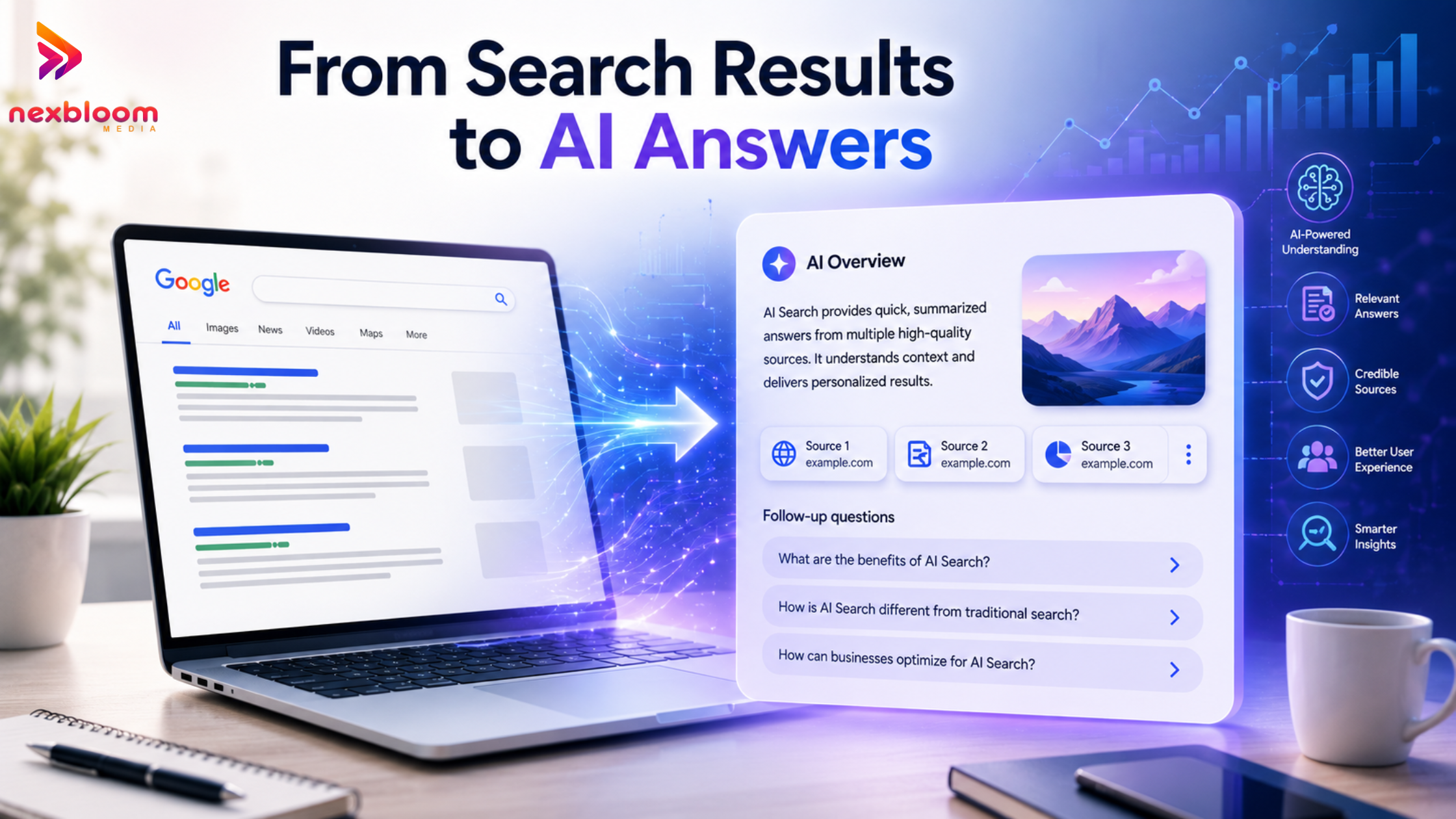
How Google’s AI Search Is Changing SEO
What Is Google’s AI Search?
Google’s AI-powered search experience uses artificial intelligence to understand a user’s query, identify relevant information, and provide a more direct answer within the search experience.
Instead of requiring users to visit several websites and combine information themselves, AI search can summarize information and provide a conversational response.
Google’s own AI features and Search documentation explains how AI-powered experiences are becoming part of Google Search.
This change is important because How Google’s AI Search Is Changing SEO affects the entire search journey.
Traditional search generally looks like:
Query → Search results → Website → Information
AI search increasingly looks like:
Query → AI-generated answer → Sources/citations → Follow-up questions → Website
That difference changes what it means to be visible in search.
How Google’s AI Search Is Changing SEO
The biggest change is that SEO is moving from ranking for individual keywords toward becoming a trusted source that search engines and AI systems can understand, reference, and recommend.
Here are the major ways How Google’s AI Search Is Changing SEO is affecting modern search strategies.
- Search Is Becoming More Conversational
Users are no longer limited to short keyword searches.
Instead of searching:
“best digital marketing agency”
A user might ask:
“What should a small business look for when choosing a digital marketing agency?”
Or:
“Which SEO strategy is best for a new local business with a limited budget?”
AI-powered search can interpret the context behind these questions.
That means businesses need content that answers complete questions, not just content designed around isolated keywords.
A strong SEO article should answer:
- What is the topic?
- Why does it matter?
- How does it work?
- What are the benefits?
- What are the limitations?
- What should the reader do next?
This is a major part of How Google’s AI Search Is Changing SEO.
- Keyword Optimization Is Becoming More Semantic
Keywords still matter, but search engines are increasingly capable of understanding relationships between words, topics, entities, and search intent.
For example, content about SEO for AI search may naturally include related concepts such as:
- Google AI Search
- AI Overviews
- search intent
- structured content
- E-E-A-T
- semantic SEO
- topical authority
- helpful content
- citations
- natural-language queries
- entity optimization
Rather than repeating the same phrase unnaturally, businesses should build comprehensive topical coverage.
For example, if your primary topic is How Google’s AI Search Is Changing SEO, supporting content can address:
- How AI search works
- AI Overviews and SEO
- AI search ranking factors
- Generative Engine Optimization
- AEO vs. traditional SEO
- How to optimize content for AI answers
- How businesses can measure AI search visibility
This creates a stronger topical relationship around the subject.
- Content Must Be Easy for AI to Understand
One of the most practical lessons from How Google’s AI Search Is Changing SEO is the importance of content structure.
AI systems need to interpret information accurately.
Well-structured content makes that easier.
Use:
Clear headings
Break large topics into logical sections.
Short paragraphs
Avoid large blocks of text that make important information difficult to identify.
Direct answers
Answer the question early before expanding with additional context.
Lists and tables
Use structured formats when comparing products, strategies, processes, or options.
Definitions
Clearly explain important terms before discussing them in depth.
FAQs
Address the questions users are most likely to ask.
This approach benefits both human readers and search systems.
Google’s Search Central documentation also emphasizes creating useful, accessible content and making pages easy for search engines to understand.
- Search Intent Matters More Than Ever
A page can contain the right keyword and still fail to satisfy the user’s actual intent.
There are generally several types of search intent:
Informational:
The user wants to learn something.
Navigational:
The user wants to find a specific website or brand.
Commercial:
The user is researching options before making a decision.
Transactional:
The user is ready to take an action or make a purchase.
AI search makes intent even more important because AI-generated answers attempt to directly satisfy the user’s underlying question.
For example, someone searching “SEO agency” may be looking for:
- A definition
- Agency recommendations
- Pricing
- Services
- Reviews
- A comparison
- A company to contact
Understanding intent allows businesses to create content that provides the right answer at the right stage.
- Authority and Trust Are Becoming Critical
AI-generated answers need reliable information.
This makes credibility increasingly important.
A website should demonstrate expertise through:
- Author information
- Original research
- First-hand experience
- Accurate information
- Relevant statistics
- Expert commentary
- Reputable references
- Consistent brand information
- High-quality backlinks
- Clear business information
The concept of E-E-A-T — Experience, Expertise, Authoritativeness, and Trustworthiness — remains highly relevant when developing content intended to perform well in search.
For businesses, How Google’s AI Search Is Changing SEO therefore also means investing in brand authority.
The goal is not simply:
“How do I rank this page?”
The bigger question becomes:
“How do I become a source Google can trust?”
- Original Content Can Become a Competitive Advantage
AI can generate generic explanations of almost any topic.
That makes generic content less valuable.
Businesses can differentiate themselves by publishing information AI cannot easily reproduce from common sources.
Examples include:
- Original case studies
- Customer experiences
- Industry surveys
- Proprietary data
- Expert interviews
- Unique frameworks
- Original research
- First-hand testing
- Before-and-after results
For example, instead of publishing another generic article about SEO, a marketing agency could publish:
“What We Learned From Optimizing 50 Local Business Websites”
That type of content demonstrates experience and provides unique information.
This is another important consideration when understanding How Google’s AI Search Is Changing SEO.
- SEO and GEO Are Becoming Closely Connected
Traditional SEO focuses heavily on visibility within search engine results.
GEO, or Generative Engine Optimization, focuses on improving the likelihood that content, brands, products, or information are surfaced within AI-generated responses.
A modern search strategy can therefore include:
SEO + AEO + GEO
SEO
Optimize websites for search engine visibility.
AEO
Optimize content to answer questions directly.
GEO
Optimize content and brand information for generative search experiences.
These strategies overlap significantly.
A well-optimized page should be useful to people, understandable to search engines, and structured clearly enough for AI systems to interpret.
- Featured Snippets and Direct Answers Still Matter
Answer-focused content is not entirely new.
SEO professionals have optimized for featured snippets, People Also Ask results, knowledge panels, and other SERP features for years.
AI search builds on this evolution.
This means content should include concise answers to important questions.
For example:
How is Google’s AI Search changing SEO?
Google’s AI Search is changing SEO by making conversational queries, content quality, topical relevance, authority, structured information, and brand visibility increasingly important alongside traditional keyword rankings.
Then the article can expand on the answer.
This answer-first structure is particularly useful for AEO and GEO because it gives search systems a clear statement to interpret.
- Backlinks Are Still Important, But Brand Mentions Matter Too
Links remain an important part of SEO because they can help search engines understand relationships and authority across the web.
However, businesses should also think about broader online visibility.
Your brand may appear in:
- Industry publications
- Review websites
- News articles
- Business directories
- Social platforms
- Expert interviews
- Podcasts
- Community discussions
- Partner websites
Consistent information across these sources can strengthen your overall digital presence.
The modern SEO strategy is therefore less about acquiring links at any cost and more about building genuine authority and recognition.
- Technical SEO Still Provides the Foundation
AI search does not eliminate technical SEO.
Your website still needs to be:
- Crawlable
- Indexable
- Mobile-friendly
- Fast
- Secure
- Accessible
- Logically structured
Important technical elements include:
- XML sitemaps
- Internal linking
- Canonical URLs
- Structured data where appropriate
- Clean URL structures
- Proper heading hierarchy
- Page performance
- Mobile usability
Google provides official documentation on structured data for businesses that want to help search engines understand their content.
Technical SEO makes the information accessible. High-quality content makes the information valuable.
You need both.
How to Optimize Your Website for Google’s AI Search
If you’re wondering how to respond to How Google’s AI Search Is Changing SEO, start with practical improvements rather than completely rebuilding your SEO strategy.
Step 1: Identify Real Questions
Use customer conversations, sales calls, support questions, forums, search suggestions, and keyword research to identify questions your audience actually asks.
Step 2: Create Answer-Focused Content
Provide a concise answer near the beginning of the page.
Then explain the topic in greater detail.
Step 3: Build Topic Clusters
Instead of publishing disconnected articles, create a central pillar page supported by related articles.
For example:
Pillar topic:
How Google’s AI Search Is Changing SEO
Supporting topics:
- Google AI Overviews Explained
- SEO vs. GEO
- How to Optimize Content for AI Search
- AEO Best Practices
- How AI Search Affects Local SEO
Step 4: Demonstrate Experience
Add examples, data, expert opinions, case studies, and original insights.
Step 5: Strengthen Internal Linking
Connect related pages so users and search engines can easily navigate your website.
Explore NexBloom Media to learn more about building a stronger digital marketing presence.
Step 6: Keep Business Information Consistent
Make sure your business name, services, contact information, descriptions, and brand details are consistent across important online platforms.
Step 7: Monitor Search Visibility
Don’t rely exclusively on traditional keyword rankings.
Track:
- Organic traffic
- Impressions
- Click-through rate
- Featured snippets
- AI search visibility
- Brand mentions
- Referral traffic
- Conversions
- Leads
For businesses looking to strengthen their broader online marketing strategy, NexBloom Media’s website is a useful starting point for exploring digital marketing services.
SEO Metrics Are Changing
One of the biggest implications of How Google’s AI Search Is Changing SEO is that rankings alone may no longer tell the complete story.
Imagine your website is mentioned in an AI-generated answer.
A user sees your brand but does not immediately click your website.
Traditional analytics might record little or no direct traffic from that interaction.
However, your brand has gained visibility.
This creates an important distinction between:
Search visibility and website clicks.
Businesses should increasingly consider metrics such as:
- Brand visibility
- Mentions
- Citations
- Qualified traffic
- Branded searches
- Conversions
- Assisted conversions
- Customer acquisition
- Search presence across multiple platforms
The objective is ultimately business growth, not simply achieving a particular keyword position.
What Should Businesses Do About Google’s AI Search?
Businesses should not abandon traditional SEO.
Instead, they should expand their strategy.
A strong modern search strategy combines:
Technical SEO + Helpful Content + Search Intent + AEO + GEO + Brand Authority
The businesses most prepared for AI search will likely be those that consistently provide useful, accurate, original, and trustworthy information.
Rather than trying to “hack” AI search, focus on becoming the best possible answer to the questions your customers are asking.
Frequently Asked Questions
How is Google’s AI Search changing SEO?
How Google’s AI Search Is Changing SEO can be summarized as a shift from optimizing primarily for keyword rankings toward optimizing for relevance, helpfulness, authority, structured information, conversational queries, and visibility within AI-generated answers.
Will traditional SEO become obsolete?
No. Traditional SEO remains important because AI-powered search still depends on discovering, understanding, and evaluating information from websites. However, SEO strategies need to evolve alongside AI-powered search experiences.
What is GEO in digital marketing?
GEO stands for Generative Engine Optimization. It is the practice of improving a brand’s visibility and representation within AI-generated search and answer experiences.
Is keyword research still important for AI search?
Yes. Keyword research remains useful for understanding what audiences search for. However, modern strategies should go beyond exact-match keywords and consider search intent, related topics, entities, questions, and conversational language.
How can I optimize content for AI search?
Create clear, useful, authoritative content that directly answers user questions. Use logical headings, concise answers, supporting details, relevant internal links, credible references, original insights, and strong topical coverage.
Does Google AI Search replace websites?
No. AI search can provide summaries and answers, but websites remain important sources of information, products, services, expertise, and transactions. Businesses should continue investing in high-quality websites and content.
Why is brand authority important for AI search?
AI-powered search needs reliable information. A strong brand presence, credible references, original expertise, consistent business information, and authoritative mentions can help establish trust and relevance.
The Future of SEO Is Search Everywhere
The most important takeaway from How Google’s AI Search Is Changing SEO is that search is becoming more dynamic.
People can discover information through traditional search results, AI-generated answers, voice interfaces, social platforms, video platforms, maps, forums, and other digital experiences.
That means businesses should think beyond:
“How do I rank #1?”
Instead, ask:
“How do I make my brand the most useful, credible, and recognizable answer to my customer’s question?”
That mindset is at the heart of modern SEO, AEO, and GEO.
Ready to Adapt Your SEO Strategy?
How Google’s AI Search Is Changing SEO is not just a future trend—it is an opportunity for businesses to improve how they create content, build authority, and connect with customers.
If your website is still relying on outdated keyword tactics, now is the time to build a more comprehensive search strategy.
Want to make your business more visible in the evolving world of Google Search and AI? Contact NexBloom Media today to build an SEO and digital marketing strategy designed for the next generation of search.